Welcome to our website !
Believe it or not, this was inspired by the mail!
One day not too long ago, I returned home from work and discovered that I had received a postcard from Denmark. The postcard depicted a stylized, graphic-designy piece of delicious-looking smørrebrød. It got me thinking how amazing it would be to actually be able to order and receive real smørrebrød in the mail - how, if it were true, I'd never have to cook again. 

My smørrebrød postcard in the mail!
Anyway, the postcard made me hungry, so I decided that I'd rip off the idea and copy, to the best of my ability, the shrimp and egg smørrebrød that was depicted on the postcard. So I went ahead and assembled the necessary ingredients (see below) and began building the Danish sandwich.

The ingredients for shrimp and egg smørrebrød

It was at this point, as I laid the ingredients out in a regimented fashion, that I was struck by the similarity between building a sandwich and building another one of my favourite Danish things  - Lego! And then it hit me, smørrebrød instructions should look like Lego instructions. 

So, without further ado, here are the instructions for making my "mail-order" smørrebrød.


Anyway, I hope you will be able to build your very own shrimp and egg Danish open faced sandwich using the above depicted steps. In case you were wondering, the version that I was eating a mere 30 minutes before writing up this blog post looked exactly like this:


I hope you enjoy this delectable Danish classic. And remember, always enjoy smørrebrød with knife and fork...and wash it down with a cold lager! SkÃ¥l!
I don't normally do restaurant reviews, but I have to tell you about my recent visit to Aamanns Copenhagen - a wonderfully authentic Danish Smørrebrød restaurant in New York City. Located in Tribeca, this is THE place to go if you want to experience Danish sandwiches that will rival the taste and quality of those found anywhere in Denmark. I'll get to what I ate in a minute, but it looked like this - very lækker!  (Yummy in Danish)


Fried fish, beef tartare and pickled herring with
fantastic Dansk rugbrød
 
For me, it was a truly wonderful experience because a) the smørrebrød was delicious and I love smørrebrød, and b) I didn't have to cook it myself for a change. What a treat!!! The restaurant itself is on Laight street (number 13) in Tribeca, just next to the intersection of Canal Street and 6th Avenue. If you want directions to the restaurant, click here.  

Image from Google Maps
I was deliberately seeking out Aamanns Copenhagen, and had a good idea what to expect from the images that I'd seen on their Facebook page, but even then, I still got a real kick out of the design of the restaurant facade when I finally saw it in person - the stark contrast of the black fonts on white background spelling our mysterious Danish words - the red and white Dannebrog flag waving languidly in the thick humid New York air - it all had a wonderfully familiar appeal - for me, I felt like I was walking into a nice restaurant somewhere in Christanhavn.  


It was a hot and humid day, and as you can see below, I scarfed down my beer so quickly, I didn't even have time to get a properly staged photo. Anyway, they boast an interesting selection of locally brewed beers - the perfect complement to a smørrebrød meal. Mine was pilsner from Brooklyn I think. I drank it too quickly to remember.

Cool Danish-looking menu
The menu offered a very nice variety of smørrebrød - something for everybody - from the most hardcore cod roe eating Dane, to the pickiest finicky lightweight girlyman eater. I have to admit, I had a hard time selecting what to eat, as I wanted to gorge myself on absolutely everything, but after a lengthy consultation with GM Morten, I decided on their fantastic fish filet, luscious beef tartare, and a selection of exquisite pickled herrings (I now dream of this pickled herring at night). I was in heaven with each and every bite. 

Aamanns Copenhagen menu
Like I said, I don't do restaurant reviews, so I am not going to dissect my eating experience. Frankly, I couldn't be objective here if I wanted to, because for me, going to Aamanns Copenhagen is akin to going to ComiCon for a 15-year old Green Arrow fan (I should have dressed up like Søren Kierkegaard), but nevertheless, in my humble opinion, the smørrebrød was absolutely delicious. 

Aerial view of beef tartare smørrebrød

Although, I was impressed by so many things about Aamanns Copenhagen, one thing that really stood out for me was the selection of house-infused Akvavits with inspired flavours I have never come across in my preferred hard booze of choice: from traditional dill to dark purple beet to toasty rye bread! They were all so good, and they paired nicely with the different smørrebrød. Plus, after 3 shots, I was feelin' fine! 

At some point, I plan on experimenting with these akvavits at home. If I have any success, I'll write it up on the blog. 

Selection of house akvavit

Another thing that really stood out for me was the fact that they are making virtually everything from scratch on site at the restaurant - this is how they ensure the quality and authenticity of the smørrebrød - and they do it all from locally sourced ingredients - exactly in the spirit of New Nordic cuisine.

If you live in, or are going to New York (lucky you!), and you want to experience smørrebrød like you find it in Denmark, you have got to go to Aamanns Copenhagen. And if you do, please send regards from DanishSandwich! 


Very hyggelig! 
And another thing...don't forget to enjoy your smørrebrød with knife and fork. SkÃ¥l!

Frikadeller, red cabbage and cucumber salad
Sometimes, you just want to eat something that gives you that hyggelig feeling of coziness and happiness. For me, when I'm in that kind of mood, a simple smørrebrød of frikadeller and red cabbage is perfect - like Danish comfort food - and it brings back fond memories of childhood Christmas vacations in Denmark.

This particular smørrebrød is one of my own personal favourite ad-libs - the Danish equivalent for rummaging through the fridge late at night when you want to scrounge together something to eat. And it's definitely a classic winter sandwich, perfect after a long day of cross-country skiing. 


Winter comfort food: Rushing home for après ski smørrebrød
The flavours and smells of this smørrebrød are very reminiscent of Danish Christmas cooking - ahhhh, just thinking about it is making me happy! I thought it was pretty funny when one of my friends commented that this sandwich "tastes like something somebody else's mother would have made". (I think she meant it as a compliment) Somehow I knew exactly what she meant - because it tastes nothing like Canadian home cooking - so you only got to eat these kinds of things when invited over to a friend's house for lunch. 


Today's Danish Diet Compass
When coupled with a crisp Danish lager, I tell myself that this frikadeller smørrebrød is part of a healthy diet - it contains all the essential nutrients as defined in my imagined version of the 1950s Five Basic Danish Food Groups as issued by the Ministry of Food, Agriculture and Fisheries (Ministeriet for Fødevarer, Landbrug og Fiskeri). These recommendations would almost certainly have included:

1) Dark Danish Rye Bread
2) Butter (or other savoury spread)
3) Meat or Fish
4) Vegetable Condiment (usually pickled, but fresh onions or sprouts are OK, too)
5) Beer (or akvavit)

If you are interested in today's honest-and-for-real Danish nutrition recommendations, as opposed to my made up ones, check out this link. 

In terms of recipes, there is nothing new in this particular frikadeller smørrebrød that you can't already find among the pages of my blog, but for the record here are the components you need and links to their respective recipes:
As always, enjoy with a fork and knife and wash it down with beer. Skål!
Cress sprouts top ham with italian salad
I live in Canada, and, like in the Scandinavian countries, locally grown fresh produce can be pretty hard to come by in the cold, dark winter months. Of course, thanks to the modern miracle of supermarkets, life in Canada isn't all scythes and root cellars; You can always buy butter, rye for rugbrød, pork for ham and rullepølse, and even assorted pickled vegetables like beets - indeed, you’ve got the four Danish food groups totally covered. But if you’re left feeling greenery-deficient from your all-smorrebrød diet in the winter months just do what I do – grow your own sprouts! In fact, sprouts are an essential component to great smorrebrød all year around for their spicy taste, texture and colour.
Sunflower sprouts will do in a pinch.
Here they are looking fine on the
veternarian's night snack!

Yeah, yeah, I know – growing sprouts is so granola - but if you want to have authentic Danish smorrebrød you'll have to work on your green thumb, because sprouts are a must, and the most common Danish sprout variety is not generally sold in stores. In typical Quebec grocery stores you can often find alfalfa, mustard, pea and sunflour sprouts. These are fine in a pinch, but none of these provide quiet the same characteristic taste you find with the most common Danish sprout variety: Cress (which is sometimes known as Pepper Grass in North America).

Growing sprouts is dead easy. All it takes are a few ingredients you can often find at your local organic health food store:

  • Seeds for sprouting
  • Nutrient rich soil
  • Food-grade hydrogen peroxide (if you’re a germ-o-phobe)
  • A container with an opaque cover 
Proof that Danes eat sprouts!
Image courtesy of:
"If Music Be The Food of Love, Play On"
Check out the blog here. 
As I mentioned above, cress is very Danish (called karse in Denmark), but if you want to mix it up from time to time, Arugula, Mustard, and other sprouts are all just as easy to grow, tasty, and almost as much fun as this.

Note on sprouting and safety: I've never had problems myself, but I've heard of food-borne illnesses related to eating raw sprouts. Misting the seeds a couple of times a day with diluted hydrogen peroxide should help, but if you want to learn more about the risks, check out this information from Health Canada.

Here’s what you do to grow your own batch of cress sprouts:

1. Fill the bottom of your container with about 2 centimeters or loosely packed soil, then lightly tamp is down to even it out. (The container I use is about 15 x 30 centimeters and about 10 centimetres high).
2. Drizzle enough water around on the soil to moisten it, but be careful not to add too much water. You don’t want the seeds sitting in mud!

3. Evenly sprinkle the seeds in a single layer across the soil.

1) Assemble your sprout-growing needs
2) sprinkle seeds on moistened soil
3) Leave seeds to sprout, covered
4) Uncover and let the magic of sunlight turn the sprouts green 
4. Give the seeds a good spray misting of water, or optionally, diluted food-grade hydrogen peroxide. This helps disinfect the seeds and reduces the chance of mold growing.
5. Cover the container and store out of the sunlight for about 3-4 days – misting the seeds lightly a couple of times a day.
6. Once the sprouts have begun to grow, you can remove the cover and place them in the sun. With exposure to the sun, the sprouts will turn nice and green.
7. Water as needed to ensure that the soil stays barely moist. Careful not to over water.
8. About 5 days after removing the cover, the sprouts will be ready to harvest. Simply grab a pair of scissors and cut about halfway down the sprout – then sprinkle liberally atop your favorite smorrebrød.
9. As always, enjoy smorrebrød with fork and knife

I am not a gardener, nor a sprout growing expert. If you want more detailed info about sprouts there are great references on the internet. Here's one sprout site that has a lot of useful information.


Sprængt oksebryst is corned beef Danish Style, and is so easy to make that I am ashamed at myself for taking so long to get around to this blog post.

It's usually made by taking the same cut of meat as beef brisket, salt curing overnight and then cooking until tender in a spiced broth. Traditionally, it is served as smørrebrød with grated horseradish and Danish "pickles" - or what we would generally call Piccalilli. And yes, it is very tasty!

I will be updating the blog post with the recipes for corned beef and Danish pickles in the very near future, so come back soon!
My rugbrøod  video has been on Youtube for almost a year now, but I thought it might be useful to make it available on my blog as well. I hope you enjoy! 

Wonderful Skagen Sild à la Nyhavn Færgekro
The point of my blog has always been to educate people about the wonders of the Danish open-faced sandwich - while eating good food and having a bit of fun at the same time. And when I set out on this adventure, I had no idea if anybody would ever read anything I posted.


Back-alley smørrebrød raid circa 1960
I optimistically imagined that quite possibly there was - somewhere out in cyberspace - clandestine groups of smørrebrød aficionados lurking in online chat rooms and disreputable torrent sites seeking any glimmer of pålæg to satisfy their secret smørrebrød fetish. Moreover I believed that deep down, these misfit Dan-o-files really just wanted a home where they could go to collectively profess their love of the Great Danish Culinary Tradition with the comforting knowledge that they were not alone.


Well, a bit more than a year has gone by, and I feel that it’s safe to say that with www.danishsandwich.com we now have a comfortable online home for those of us outside Denmark who want to indulge in their love of smørrebrød. I also feel that through the blog and the support of everybody out there, more people know about smørrebrød today than they did a year ago – and I feel very grateful to all my followers for the support and encouragement. Hopefully year 2 will bring even greater smørrebrød enlightenment! 

Aside from introducing new-comers to the wonder of smørrebrød, another great benefit of the blog is that it has allowed me to meet and get to know people across Canada and in the rest of the world who share my passion for Danish cuisine and culture. Many of these people have generously shared their personal stories with me, and even introduced me to their favorite recipes, including some for new Danish smørrebrød that I did not know about!

So in this blog post, I'm going to share one of these recipes with you. It comes courtesy of Steve (A.K.A @StreetCuisine) from Toronto, whose blog AdventureFood has many rich and entertaining posts about food from around the world - including several posts about Danish food.


The recipe is for Skagen Sild, which is a sandwich topping made from pickled herring in a creamy white sauce. The word Skagen refers to a magical place in Denmark (read more about it here), and Sild means herring. So, Skagen Sild is basically a herring salad from Skagen. Yum!

To me, Skagen Sild seems very similar to another famous Danish sandwich topping - called Frokostsild (meaning lunch herring). I had never made such a smørrebrød topping before, so I was very eager to try out Steve’s recipe! And the provenance of the recipe is stunningly impeccable, as Steve used to work as a chef in a well-known Copenhagen restaurant. So you know you're getting the real deal with this one!!!

As far a smørrebrød goes, this recipe is easy to make (Danish Degree of Difficulty: Easy) provided you already have pickled herring filets. If you do not have pickled herring, you can either buy it in jars (for instance, at IKEA), or read about how to make it here.
Skagen Sild in my kitchen

So, without further ado, here is the recipe for Skagen Sild (with a big thanks to Steve @StreetCuisine).

  • 6 pickled herring fillets, rinsed and cut into 1 cm pieces
  • 3 tbsp sour cream
  • 2 tbsp mayonnaise
  • 1 tsp Dijon mustard
  • 1 shallot, finely diced 
  • half an apple, diced
  • 1 tsp cracked pepper
  • 1 tbsp chopped dill
  • Slices of buttered Danish rye bread
The instructions are straight-forward. Combine all the ingredients (except for the bread) in a bowl and chill in the refrigerator for a couple of hours. This helps blend the flavours together nicely. Finally, serve with buttered rye bread and chopped chives. And as always, enjoy with fork and knife!

If you’d like to read Steve’s post on Skagen Sild, you can find it here.

Now, let's discuss that restaurant in Copenhagen. It's called Nyhavns Færsekro, and while I have never been there, I have been told by experts that it is one of the few respected establishments in an area rife with tourist traps - Nyhavn. In fact, this is arguably the most touristic part of Copenhagen (akin to the Champs-Elysees in Paris, Las Ramblas in Barcelona, or Crescent Street in Montreal).

Nyhavn: Pretty by day, pretty lively at night!
Originally Nyhavn served as a gateway from the sea to the city centre and it had a bad reputation: it was a disreputable hangout for sailors in search of beer and hookers. But, alas, no longer! Nevertheless, Nyhavn is worth a visit: it is a very pretty pedestrian canal street in the centre of town, chock full of beautifully restored sail boats and lined with picturesque multi-colored row apartments housing over-priced cafés - together it has all become emblematic of Copenhagen and has a visual aura that harkens back a couple of centuries. 

The word Nyhavn can be translated as follows: Ny=new, havn=harbor. Thus Nyhavn means New Harbour. You can learn more about Nyhavn here. 
 
Me, chillin' in Nyhavn, 
waiting for my Stjerneskud
So if you find yourself in Nyhavn, and are craving a 
smørrebrød, seek out the restaurant called Nyhavns Færsekro. Or if nothing else, grab a seat at a Nyhavn cafe, order a cold beer and sit watching the people go by - it's a great way to absorb Danish culture when you're in Copenhagen.

Once in a while, we all just want something that is easy to make and tastes great, right? When I'm in that kind of a mood, this smørrebrød, a variation on the classic roast beef with pickles and fried onions, is a completely delicious treat that is both a personal favorite of mine and a sure-fire crowd pleaser.
Roast beef with remoulade and fried onions! Amazing!
For this sandwich, you'll need:
Sliced Roast Beef - I recommend roasting the beef yourself, ideally using a meat thermometer to properly gauge when the meat is cooked. It's pretty simple: Coat the roast with salt, pepper, and thyme then brown on all sides in a frying pan. Then pop it in the oven at 350F until you reach 145F on the meat thermometer. This gives you a roast that is cooked to medium.
Roast until a 145F internal temperature
Once the roast is cooked, remove it from the oven and set it aside while you prepare the other ingredients. Also, I find it much easier to slice thinly once its cooled off a bit. 
Cool roast and slice thinly
Remoulade - Remoulade is a condiment that is something like tartare sauce. I add one good dollop to each sandwich, which has a tart taste and crunchy texture and goes so well with roast beef.
Remoulade: Before and After
You can make enough remoulade for four sandwiches by combining:
  • 1/4 cup Mayonnaise
  • 1 TBSP Dijon Mustard
  • 3 TBSP Diced Pickles
  • 1 TBSP Chopped Capers
  • 1 TBSP Chopped Taragon
  • 1/4 tsp powdered tumeric (to give a yellow color)
  • Salt and pepper to taste
Fried Onions - Crispy and addictively delicious on their own (like potato chips), fried onions provide the perfect savoury flavour and crisp to round out this (and probably any other) smørrebrød. To make them, take half a large white onion and slice it thinly. Dredge the onion slices in a few tablespoons of flour (I like to use rye). Meanwhile, heat about a cup and a half of canola oil in a heavy-bottomed pot over medium-high heat. Once the oil is hot, add the floured onions in 2 batches. Stir occassionally with a slotted spoon (not plastic!) The onions are done when they are golden brown. Remove from oil and place them on paper towel to soak excess oil. Continue until all onions are fried.
1) Flour the sliced onions
2) Fry them in canola oil
3) Remove to paper towel and enjoy atop smorrebrod
And if you're feeling crazy, you'll want to add some shaved horseradish root to give it a little extra kick! Now you are ready, so combine all the ingredients atop buttered Danish rye bread and enjoy with fork and knife sitting at your kitchen table. A cold beer to wash it down, and all is right in the world.
To be enjoyed heartily - always with fork and knife
Or better yet, pack a roast beef & remoulade smørrebrød picnic basket and head out in search of a magical spot - preferably somewhere in the Danish countryside, somewhere where Vikings roamed the lands. Maybe even find a spot marked by Viking burial stones arranged into the shape of a longship. Then, once you've found this spot, wait for a rainbow to appear. And then, only then, enjoy your picnic while contemplating the fact that the mighty Thor himself may have once travelled to Earth across Bifrost (the Rainbow bridge) to this very spot and handed a reasonable facsimile of the sandwich that you are now eating to a passing human. And imagine that it was thus that the gods gave this wonderful smørrebrød to be enjoyed by all who can make it!!! 
Yes, I was really present when this phenomenon occurred!!!
Was it perhaps Odin passing on the secrets of smørrebrød to me?

I love a good agurkersalat - the popular Danish condiment made from freshly pickled dill cucumbers. For me, the wonderful tart freshness of the sour/sweet cucumber dish is a perfect complement to many an open-faced sandwich. And while it is available in shops in Denmerk, here in Canada, you need to make it yourself if you want to experience this deliciously-Scandianvian taste (which for me is a complete no-brainer, since it easy, and tastes so much better this way anyway).

Agurkersalat: Ready to eat!
Here are the basic ingredients you will need to make your agurkersalat (but as you will see, you can experiment):
  • 1 whole seedless cucumber - sliced thinly
  • 1 TBSP salt
  • 1 1/2 cups vinegar
  • 2 TBSP sugar
  • 3 TBSP chopped dill
  • A bit more salt and pepper, to taste
Instructions for Making Agurkesalat
  1. Using a sharp knife, thinly slice the entire cucumber.
  2. Place the sliced cucumber in a bowl and toss with the coarse salt. The salt will help suck out the liquid from the cucumber flesh.
  3. Put a small plate on top of the cucumbers in the bowl and weigh it down with a jar or other weighted object.
  4. After about 2 hours, you will notice that the cucumber slices are basically sitting in a bowl of salty water. Drain the salty water, squeezing out as much excess liquid as possible (without crushing the cucumber).
  5. Combine vinegar and sugar, heating slightly if necessary to dissolve. Make sure to cool thoroughly before adding to sliced cucumbers.
  6. Pour in the vinegar/sugar and stir in the chopped dill. Allow the mixture to sit in the refrigerator for a couple of hours (or overnight) before using to allow the flavours to blend.
OK, so that was la methode traditonelle - Anyway, I decided to play around with different locally available vinegars, to see what the resulting agurkersalat would be like. A delicious revelation? A disgusting aberration worthy only of contempt? Risks aside, this seemed like a good idea to me, since pickled condiments are such a big part of smørrebrød and I wanted to get a sense of whether I could improve my recipes by simply modifying the basic ingredients.

I went to the local supermarket to raid the vinegar section, thinking there would be a good selection of artisanal vinegars, but was dismayed to find about 25 varieties of Maille French vinegar a few boring looking Pastene options. So I left and went to my favorite green grocer. Here I found a couple of what seemed like worthy options. They were:

L'Ancestral Apple Cider Vinegar - A commonly available Quebec cider vinegar, which for my taste buds is a little too rough around the edges - but who knows, maybe it's great in agurkersalat (costs about $5 a bottle). Read more about it here.

Verger Corriveau Apple Cider Vinegar - A high-end artisanal vinegar with an exquisitely balanced fruit apple flavour - so nice you can almost drink it. (costs about $13/bottle)

I also decided to use a bottle of Allen's White Vinegar as my control.

BTW, if you are interested in really fine vinegars, check out the vinegar offerings from Claus Meyer's Nordhavn Vinegar Brewery in Copenhagen - I wish we could get these vinegars in Quebec!
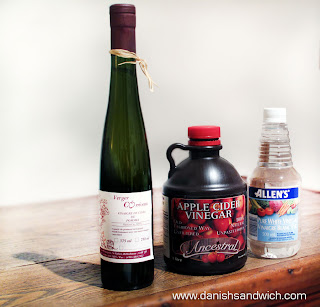

Contestants in the agurkersalat vinegar death match
Next, I had to make some choices around the sweetener I would use to balance out the tangy vinegar. Normally, I'd just use a couple of table spoonfuls of organic sugar, but in the death match, I needed something more interesting. I opted for an  amber maple syrup and buckwheat honey from Miels d'Anicet (awesome locally-produced organic honeys - not cheap, but so good. You can find out more about it here). And of course, plain white table sugar as the control substance.

The three different pickling liquids (left to right)
1) White vinegar and plain sugar
2) L'Ancestral vinegar and maple syrup
3) Verger Corriveau & d'Anicet honey
And of course the cucumber. For this I used a seedless English variety, but I like the idea of trying the Lebanese kind becasue of its smaller size (something for another day).


Once the cucumbers were salted and drained, I divided them up along with the chopped dill between the three pickling liquid "contestants" and let them sit overnight to absorb the lovely flavours.
The three contestants, ready for their moment in the spotlight
Finally, it was time for the taste test. I gathered up my small group of smørrebrød experts and prepared our tasting samples. We used small, canapé-sized, slices of Danish rye bread with leverpostej (liver paté) as the base upon which to taste the agurkersalat. And then we went to town!

The main event!
So, who was the winner?

The judges were split, but we unanimously agreed that the maple syrup + Ancestral Cider Vinegar came in last of the three  - it just didn’t taste right - adding bitter flavours that in my opinion were not complementary to the smørrebrød as a whole. On the other hand, the other two contestants both received high scores for providing that clean, tart taste we love with agurkersalat. For my money, the pickling liquid made from the Verger Corriveau cider vinegar was more interesting with complex fruitiness and the perfect balance of acid to sweetness, but in reality, the agurkersalat made from white vinegar and plain sugar did just fine in terms of making a good, fresh tasting condiment. All in all, it was a great battle!

And now, since I always like to toss a bit about Denmark in my posts, you'll notice that in the background of one of the taste test photo above there is a Danish flag. This type of adornment is a common thing to do in Denmark for birthday parties and holiday meals - basically to add a festive atmosphere to the food and dining table. I think this is just another example of one of those small details that goes in to making the Danish meal experience "hyggelig" (or cozy). 

Regarding the Danish flag, known as the Dannebrog, you probably didn't know it, but this is the world's oldest state flag in use by an independent nation, dating back to the early 1200s. The word Dannebrog litereally means "Danish Cloth." The flag features a white cross on a red background (the white cross for Christianity, the red probably for the armed forces or some such thing). Read more about the Danish National Flag here.  
Of course, in true Danish tradition, there is a good story behind the origin of the flag. Here it is: Danish forces were engaged in a fierce fight, and were getting thumped badly, during the Battle of Valdemar in Estonia (in 1209). They were about the surrender, when the flag literally fell from the heavens. The King grabbed the falling flag before it hit the ground, then waved it magestically to motivate the troops to victory. The Danes have used the flag ever since.  

There is a painting by Christian August Lorentzen from 1809 that is located in the Copenhagen museum Statens Museum for Kunst depicting the legendary moment that the Dannebrog fell from the sky. You can see it here.


Rye bread slicer
One thing about Danish Rye bread that used to drive me crazy...it can be a pain to slice, especially if you eat it all the time like I do! The dense, thick loaf practically requires a saw and a burly lumberjack just to hack it into rough-hewn pieces. And yet, the Danes use this bread sliced thinly, with near surgical precision, as the base upon which they build their delicious smørrebrød sandwiches. I used to wonder how they did it!

I should have known that the Danes had solved this little problem with an ingeniously medieval-looking device called a rugbrødsmaskine. This device, which could serve many a nefarious purpose from the looks of it - is used in Denmark for quickly and easily slicing Danish rye bread. And what a joy it is!

Check out this video of my rye bread "guillotine" in action!


I imagine you can still find these cool kitchen devices today in better Danish kitchenware shops, but I found mine at a Danish flea market. It cost me about 100 kroner (about 20 bucks) and has been worth every penny!

A company called Raadvad, which today is known primarily for its knives, has been making this device since the late 1800's. Check out their web page for an amazing picture of one of the originals - it's hardly changed in over a hundred years!!!