Welcome to our website !
I love a good agurkersalat - the popular Danish condiment made from freshly pickled dill cucumbers. For me, the wonderful tart freshness of the sour/sweet cucumber dish is a perfect complement to many an open-faced sandwich. And while it is available in shops in Denmerk, here in Canada, you need to make it yourself if you want to experience this deliciously-Scandianvian taste (which for me is a complete no-brainer, since it easy, and tastes so much better this way anyway).

Agurkersalat: Ready to eat!
Here are the basic ingredients you will need to make your agurkersalat (but as you will see, you can experiment):
  • 1 whole seedless cucumber - sliced thinly
  • 1 TBSP salt
  • 1 1/2 cups vinegar
  • 2 TBSP sugar
  • 3 TBSP chopped dill
  • A bit more salt and pepper, to taste
Instructions for Making Agurkesalat
  1. Using a sharp knife, thinly slice the entire cucumber.
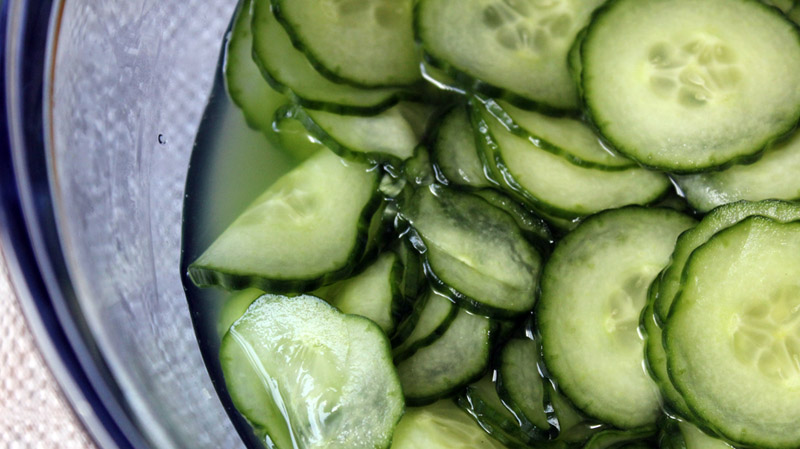
  2. Place the sliced cucumber in a bowl and toss with the coarse salt. The salt will help suck out the liquid from the cucumber flesh.
  3. Put a small plate on top of the cucumbers in the bowl and weigh it down with a jar or other weighted object.
  4. After about 2 hours, you will notice that the cucumber slices are basically sitting in a bowl of salty water. Drain the salty water, squeezing out as much excess liquid as possible (without crushing the cucumber).
  5. Combine vinegar and sugar, heating slightly if necessary to dissolve. Make sure to cool thoroughly before adding to sliced cucumbers.
  6. Pour in the vinegar/sugar and stir in the chopped dill. Allow the mixture to sit in the refrigerator for a couple of hours (or overnight) before using to allow the flavours to blend.
OK, so that was la methode traditonelle - Anyway, I decided to play around with different locally available vinegars, to see what the resulting agurkersalat would be like. A delicious revelation? A disgusting aberration worthy only of contempt? Risks aside, this seemed like a good idea to me, since pickled condiments are such a big part of smørrebrød and I wanted to get a sense of whether I could improve my recipes by simply modifying the basic ingredients.

I went to the local supermarket to raid the vinegar section, thinking there would be a good selection of artisanal vinegars, but was dismayed to find about 25 varieties of Maille French vinegar a few boring looking Pastene options. So I left and went to my favorite green grocer. Here I found a couple of what seemed like worthy options. They were:

L'Ancestral Apple Cider Vinegar - A commonly available Quebec cider vinegar, which for my taste buds is a little too rough around the edges - but who knows, maybe it's great in agurkersalat (costs about $5 a bottle). Read more about it here.

Verger Corriveau Apple Cider Vinegar - A high-end artisanal vinegar with an exquisitely balanced fruit apple flavour - so nice you can almost drink it. (costs about $13/bottle)

I also decided to use a bottle of Allen's White Vinegar as my control.

BTW, if you are interested in really fine vinegars, check out the vinegar offerings from Claus Meyer's Nordhavn Vinegar Brewery in Copenhagen - I wish we could get these vinegars in Quebec!


Contestants in the agurkersalat vinegar death match
Next, I had to make some choices around the sweetener I would use to balance out the tangy vinegar. Normally, I'd just use a couple of table spoonfuls of organic sugar, but in the death match, I needed something more interesting. I opted for an  amber maple syrup and buckwheat honey from Miels d'Anicet (awesome locally-produced organic honeys - not cheap, but so good. You can find out more about it here). And of course, plain white table sugar as the control substance.

The three different pickling liquids (left to right)
1) White vinegar and plain sugar
2) L'Ancestral vinegar and maple syrup
3) Verger Corriveau & d'Anicet honey
And of course the cucumber. For this I used a seedless English variety, but I like the idea of trying the Lebanese kind becasue of its smaller size (something for another day).


Once the cucumbers were salted and drained, I divided them up along with the chopped dill between the three pickling liquid "contestants" and let them sit overnight to absorb the lovely flavours.
The three contestants, ready for their moment in the spotlight
Finally, it was time for the taste test. I gathered up my small group of smørrebrød experts and prepared our tasting samples. We used small, canapé-sized, slices of Danish rye bread with leverpostej (liver paté) as the base upon which to taste the agurkersalat. And then we went to town!

The main event!
So, who was the winner?

The judges were split, but we unanimously agreed that the maple syrup + Ancestral Cider Vinegar came in last of the three  - it just didn’t taste right - adding bitter flavours that in my opinion were not complementary to the smørrebrød as a whole. On the other hand, the other two contestants both received high scores for providing that clean, tart taste we love with agurkersalat. For my money, the pickling liquid made from the Verger Corriveau cider vinegar was more interesting with complex fruitiness and the perfect balance of acid to sweetness, but in reality, the agurkersalat made from white vinegar and plain sugar did just fine in terms of making a good, fresh tasting condiment. All in all, it was a great battle!

And now, since I always like to toss a bit about Denmark in my posts, you'll notice that in the background of one of the taste test photo above there is a Danish flag. This type of adornment is a common thing to do in Denmark for birthday parties and holiday meals - basically to add a festive atmosphere to the food and dining table. I think this is just another example of one of those small details that goes in to making the Danish meal experience "hyggelig" (or cozy). 

Regarding the Danish flag, known as the Dannebrog, you probably didn't know it, but this is the world's oldest state flag in use by an independent nation, dating back to the early 1200s. The word Dannebrog litereally means "Danish Cloth." The flag features a white cross on a red background (the white cross for Christianity, the red probably for the armed forces or some such thing). Read more about the Danish National Flag here.  
Of course, in true Danish tradition, there is a good story behind the origin of the flag. Here it is: Danish forces were engaged in a fierce fight, and were getting thumped badly, during the Battle of Valdemar in Estonia (in 1209). They were about the surrender, when the flag literally fell from the heavens. The King grabbed the falling flag before it hit the ground, then waved it magestically to motivate the troops to victory. The Danes have used the flag ever since.  

There is a painting by Christian August Lorentzen from 1809 that is located in the Copenhagen museum Statens Museum for Kunst depicting the legendary moment that the Dannebrog fell from the sky. You can see it here.


Frikadeller smørrebrød - the perfect way of dispatching those leftovers!
Frikadeller are Danish meatballs and are commonly eaten as part of the evening meal, and served perhaps with boiled potatoes. They are also great placed either warm or cold atop smørrebrød. Flavourful and oh so light, there are as many frikadeller recipes in Denmark as their are households - and these treasured family secrets are passed on from one generation to the next. But, in fact, there is only one true frikadeller recipe - the one recipe to rule them all - and it is guarded deep inside the most secure vault in all of the Kingdom of Denmark.

The recipe itself for frikadeller is written in the original manuscript of THE definitive guide to Danish cuisine - Frøken Jensens Kogebog - handwritten by the venerable lady of the Danish kitchen herself in 1901. It is also said that the original copy of the unabridged handwritten manuscript (not the commonly published concise edition you can still find in stores today) lists and details the twenty-five "official"smørrebrød - if it is not in the original Frøken Jensens Kogbog, then it is not really smørrebrød. And while I have not seen it with my own eyes, the ancient tome purportedly contains an even lengthier list of things one must not combine together when making danish open-faced sandwiches (ham, blue cheese and pickled herring anybody? Frøken Jensen said "Nej!").

Secret location of frikadeller recipe...
While it is a closely guarded national secret, I can reveal to you here that the vault's location is actually in central Copenhagen, deep inside the basement of the beautiful Rosenborg Castle. The vault uses the most advanced anti-theft technology to ensure that Denmark's greatest treasures are kept safe and sound. Not coincidentally, this vault is also home to other precious national treasures, such as the crown jewels of the Danish royal family, which are on display behind thick bulletproof glass out of the reach of tourists and robbers alike. Hundreds of sensors are constantly vigilant for the slightest sign of trouble, and at the slightest whiff of risk, the ultra-secure environment shuts down tighter than Fort Knox - with 8 inch thick steel doors slamming shut in an instant - entrapping anybody caught inside the vault - long before escape is possible.

The frikadeller recipe is a closely guarded secret!
Ok, ok! So none of this is true about the secret location of the frikadeller recipe, the official smørrebrød list, or even the handwritten Frikadeller recipe, but Rosenborg Castle is real, it is highly secure, and it is in Copenhagen. As a child, my imagination was captivated by the seemingly impenetrable safe, and I assumed that it housed secrets even more wonderful than the priceless treasures actually on display - treasures like the secrets of smørrebrød.

Rosenborg Castle in Copenhagen
Rosenborg Castle was built in the Dutch Renaissance style in 1606 and was used as a summer residence by King Christian IV as well as other Danish kings. Today, the castle serves as a museum, with many interesting historical artefacts on display including the original crown from the coronation of King Christian IV himself in 1596. Find out more about the Rosenborg Castle museum here.

All this is very interesting, but I am sure that by now you are dying to know how to make frikadeller! So enough of the suspense - here is what you need to know:

Use good meat and grind it yourself
To begin with, frikadeller can be made from different types of ground meat including beef, veal, and pork. I believe the best frikadeller have at least 50% pork, and to ensure the tastiest meat balls, you should use the best possible lean meat you can buy - for instance pork loin, veal cutlets, and so on. This means you'll have to grind the meat yourself (or ask the butcher to do it for you), since typical store ground meats are very high in unnecessary fat. You will find the recipe for frikadeller below.

In terms of using frikadeller for smørrebrød, this is very common in Denmark as a way of using up leftovers from the previous night's dinner, and there are actually a few different accompaniments that you can use - agurkesalat, rødkÃ¥l, asier and even pickled red beets - all of these sweet and sour toppings compliment the light, savory flavour of meat balls when eaten on top of buttered Danish rye bread.

Variety is the spice of life!
Ingredients for making frikadeller:

Grind pork, veal and onion
together a few times

  • 250 grams of finely ground pork
  • 250 grams of finely ground veal
  • 1 medium onion, ground finely along with the meat
  • 1 large egg
  • 350 ml soda water
  • 1 tsp salt
  • 3 tbsp flour (rye or wheat)
  • a pinch or two of ground all-spice
  • freshly ground pepper to taste
  • Butter for frying
Instructions

1) Combine all the ingredients (except the butter) in a bowl. The mixture should be quite moist and soft.

Frikadeller ingredients - ready to mix!
Mixture too soft to handle
2) Place a non-stick frying pan over medium-high heat, and then melt a couple of table spoons of butter in the frying pan. You will be frying the meatballs in batches.

3) Using a pair of spoons, form the meatballs and place them, one-by-one, in the hot frying pan. Don't put too many frikadeller in the pan at once, or they will boil instead of fry! The frikadeller should not be touching.

Form frikadeller with a couple of spoons 
4) Cook the meatballs for about 3 minutes, and then flip gently (I use a couple of knives for this manoeuvre).  

Fried in batches - don't add too many to the pan at once!
5) Cook for 3 minutes more and then remove the frikadeller to a separate platter. Add more butter and then fry another batch.

6) Once you are  ready for smørrebrød, butter a pice of dark Danish rye bread, slather it with Dijon mustard, place a couple of sliced meatballs on the mustard, and then top it with an appropriate pÃ¥læg (for instance, agurkesalat or even dill pickles). Make sure you enjoy with a cold lager beer and a fork & knife.


Pork sausage with cucumber salad (Medisterpølse med agurkersalat)
Danish pork sausages are traditional and simple to make, at least as far as sausages go. They are great on their own as a main course, and the leftovers make excellent smørrebrød when sliced up and placed on top of buttered Danish rye bread. While there are a number of pickled condiments that compliment medisterpølse, I prefer the fresh and tangy taste of Danish cucumber salad (agurkesalat) to go with lightly spiced pork sausages. And to wash it down? Cold beer. "Skål!"

Lightly Spiced Danish Pork Sausage - Medisterpølse
Agurkesalat
Actually, agurkesalad is a very common Danish side-dish, one that can easily be purchased prepared in any Danish grocery store. It is easy to make and requires only a few ingredients, but requires a bit of time, as you must first salt sliced cucumber to extract the water contained in the gourd-like fruit. Seedless English cucumbers are the best for making agurkesalat.

If you've ever been to Denmark, you probably noticed that there are many fast food-style hotdog vendors around the city with their own small stands. These pølsevogn, as they are called, sell an assortment of different ready-to-eat sausages - from the disgustingly red rødpølse to some slightly more natural looking fried offerings such as ristet pølse. Keep in mind that these hot dogs are essentially Danish fast food, and while they are occasionally served with agurkesalat, they have nothing in common with the delicious, home-made medisterpølse described in this blog post.

Left: Polsevøgn in Copenhagen
Centre: Mysteriously red rødpølse
Right: Ristet pølse with fried onions and agurkesalat
In order to make Danish pork sausage smørrebrød, you will need:

  • 1 slice of buttered Danish rye bread
  • 1 medisterpølse, cooled (recipe below)
  • 1-2 tbsp agurkesalat (recipe below)
  • Dijon mustard to taste 

I love writing this blog, as it gives me an excuse to spend time every weekend thinking about my favorite topic - food! However, no blog post would be complete without a completely gratuitous digression on topics seemingly unrelated to eating - this week that topic is "Holger Danske."

Statue of legendary Danish hero
Holger Danske
sleeping in the basement of
Kronborg Castle
Holger Danske is a legendary Danish hero who fought as a mercenary along-side Charlemagne in the 8th century. The legend states that in his entire, highly decorate career as a mercenary, he never once lost a battle, but after years of fighting abroad he grew homesick (craving smørrebrød?). So, he did what all homesick Danish mercenaries would do when finished fighting in the South of France during the Dark Ages - he walked back to Denmark.

He walked all the way to the town of Helsingør, home to Castle Kronborg, where he sat down, exhausted, and immediately fell asleep. And he still sleeps there today in the basement of Kronborg. According to legend, however, Holger Danske will awaken if an enemy comes along to threaten Danish sovereignty. So it may come as no surprise that, during the Second World War when Denmark was occupied by the Nazis, the Danish Resistance fighters named themselves Holger Danske.

So what does this have to do with smørrebrød? For most Danes, absolutely nothing. But for me, as a child growing up in Canada, my father would tell me the story of the Holger Danske and warned me that if I ever made smørrebrød that did not adhere to the strict Danish manner, Holger Danske would awaken from his deep slumber - somehow walk to Canada - and do unspeakably terrifying Viking-things to me as punishment for threatening Danish tradition.

As I mentioned, Holger Danske sleeps in the basement of Kronborg castle in Helsingør (Elsinore). This very same castle is famous for another reason. According to William Shakespeare, it is none other than Elsinore Castle, former home of the Prince of Denmark, the tragic figure Hamlet. (Interested in a transcript of Shakespeare's Hamlet?)

Kronborg Castle - former home of Hamlet, King of Denmark -
current home of Holger Danske
And what does this have to do with smørrebrød? Again, nothing, unless, like me, you've initiated countless numbers of non-Danes to the traditions of Danish open-faced sandwiches. Admittedly, Denmark is a small country, and most North Americans have limited knowledge about the tiny Kingdom. Yet everybody seems to know the Little Mermaid and Hamlet. And inevitably, when mentioning Hamlet, they cite the famous line by Marcellus: "Something is rotten in the State of Denmark" followed by a cleverly improvised "let's hope it isn't the herring we're about to eat!" 

Anyway, let's get back to our medisterpølse. Here's what you need to know.

First of all, the Danish Degree of Difficulty is a Holger Danske Hard - mainly because of the time it takes and the special sausage-making equipment you will need. Also, when it comes to making sausage, I highly recommend you grow a third arm, or better yet, enlist the help of a friend.

Well-marbled pork shoulder
For really great sausage, the key is really great pork. The question is what cut is the best. While I have a fair amount of sausage making experience, I decided to enquire with my friends at Pork Futures - these guys are the experts in making all manner of delicious pork sausages using the freshest organic ingredients. They recommended well-marbled pork shoulder with the option of adding extra back fat depending on how "juicy" you like your sausages. Also, be sure to keep everything as cold as possible. This minimizes the risk of unwanted bacteria forming and keeps the fat from melting into the meat.

Ingredients for Making Danish Pork Sausage

To make medisterpølse, you will need:

  • about 2 kg refrigerated pork shoulder (plus the option of additional back fat)
  • 1 large white onion
  • 500 ml beef broth (preferably homemade), cooled
  • 1 1/2 tbsp salt
  • 1 tsp ground all-spice
  • 1 1/2 tbsp ground black pepper
  • 1/2 tsp each ground clove, nutmeg, and ginger
  • at least 3 meters of pork casing (available at good butchers)
  • For cooking - 2 bay leaves + 2 tbsp butter
1) Slice about 2 kilos of pork shoulder into cubes. Then run the meat through a meat grinder using the fine setting. If you are using extra fat, grind it, too).

Grind the meat
2) Chop the onion, and run it through the meat grinder. Then thoroughly mix together the meat, onion, spices, and broth using your hands. Fry up a small amount of the mixture to taste for seasoning. If needed, adjust seasoning to taste (for instance, add a bit more salt).

Combine the ingredients
4) Add a medium-sized sausage attachment to your meat grinder and load a couple of meters of casings onto the sausage stuffer (spigot).

Sausage casings are loaded
up and ready to go


5) Fill the casing with the sausage stuffing. With medisterpølse, you do not create links. Instead, you create long coils about one meter long each that you cook all at once.

Coiled medisterpølse, ready for cooking. 
6) Place coil in a large frying pan, cover with water, add 2 bay leaves, and bring to a boil. Reduce heat to simmer for about 15 minutes.

Simmering sausage
7) Drain cooking liquid and remove sausages temporarily to a plate. Cut the sausages into pieces about 30 cm long. Meanwhile, return frying pan to stove set at medium-high heat. Melt 2 tbsp butter and fry entire coil of sausages until golden brown all over.

Yum!


Making Agurkesalat

Now for the agurkesalat - everybody's favourite Danish side-dish! Why buy it at the store when you can make it yourself!

Here is what you need to know:

Ingredients for Agurkesalat

  • 1 English cucumber, washed
  • 1 tbsp coarse salt
  • 250 ml white vinegar
  • 3 tbsp chopped dill
  • Freshly ground black pepper

Instructions for Making Agurkesalat


1) Using a sharp knife, thinly slice the entire cucumber.

2) Place the sliced cucumber in a bowl and toss with the coarse salt. The salt will serve to pull out the liquid from the cucumber flesh.

Toss cucumber with coarse salt
3) Put a small plate on top of the cucumbers in the bowl and weigh it down with a jar or other weighted object.
Cucumbers weighted down
4) After about 2 hours, you will notice that the cucumber slices are basically sitting in a bowl of salty water. Drain the salty water, squeezing out as much excess liquid as possible (without crushing the cucumber).

Cucumbers sitting in their brine
5) Pour in the vinegar and stir in the chopped dill. Allow the mixture to sit in the refrigerator for a couple of hours before using to allow the flavours to blend.